AI content generation for 14,000 restaurants
Production AI tools that compressed restaurant content creation from hours to minutes. Shipped to 14,000 restaurants. Contributed to Fiserv's $320M acquisition.
role: Director of Product Design
client: BentoBox
dates: 2023 to 2024
team: Led 3 designers, 2 PMs, 6 engineers, 1 ML engineer
scope: [0 to 1] [ai-native] [production shipped]
## Frame
In 2023, before AI content tools were a category, BentoBox was bleeding adoption at the content creation step. Restaurant operators (chefs, owners, GMs) were signing up for the platform, hitting the part of the workflow where they had to generate menu descriptions and marketing copy and email campaigns, and never coming back. The platform served 14,000 restaurants. The leverage point was clear. Build AI content generation tools, ship them to the install base, and measure whether self-serve adoption moved. The catch: this was the early end of the wave. The tools that exist today did not exist yet. We had to build the product, the prompts, and the trust layer, all from scratch.
## Diagnosis
I started by spending two days in restaurants, watching operators try to use the platform's content tools as they existed. Three things were obvious within the first hour.
Restaurant operators are not marketers. They know their food. They do not know how to write a description that sells the food. The cognitive distance between "I made this dish" and "here is the copy that makes someone want to order it" is the entire job of a marketing department, and BentoBox was asking small business operators to do that job in addition to running the restaurant.
The existing content workflow was a blank text field. It treated the operator as if they were a copywriter who just needed somewhere to type. The blank text field was the abandonment point.
And operators did not trust generic AI. The first wave of AI content tools in 2023 produced text that was technically grammatical but tonally wrong for hospitality, which is a category where voice is the product. A description that sounded like a chain restaurant in a place that was trying to be a neighborhood spot was worse than no description at all.
## Decision
Three calls shaped the AI work.
First, the AI had to know the restaurant. Generic AI was the wrong product. The tools we shipped were grounded in the restaurant's existing content (their menu, their about page, their previous marketing) and tuned to their voice. Operators saw outputs that sounded like them, not like ChatGPT, because the system had read their entire site before generating anything. The trust layer was that the AI was an extension of the operator's existing voice, not a replacement for it.
Second, never start from a blank field. Every AI surface in the platform led with a draft, not a prompt. Operators saw three options for a menu description before they saw the input field. The job became editing, not writing. This was a deliberate inversion of the standard AI UX of the time, which was prompt-and-pray.

Third, ship narrow tools, not a chatbot. The tools were specific: menu description generator, email campaign drafter, hero image suggester, social post composer. Each one solved a single task that operators were already trying to do. We did not give them an AI assistant. We gave them AI for the four tasks that were costing them the most time, and made sure each one was excellent at its specific job.
## Work
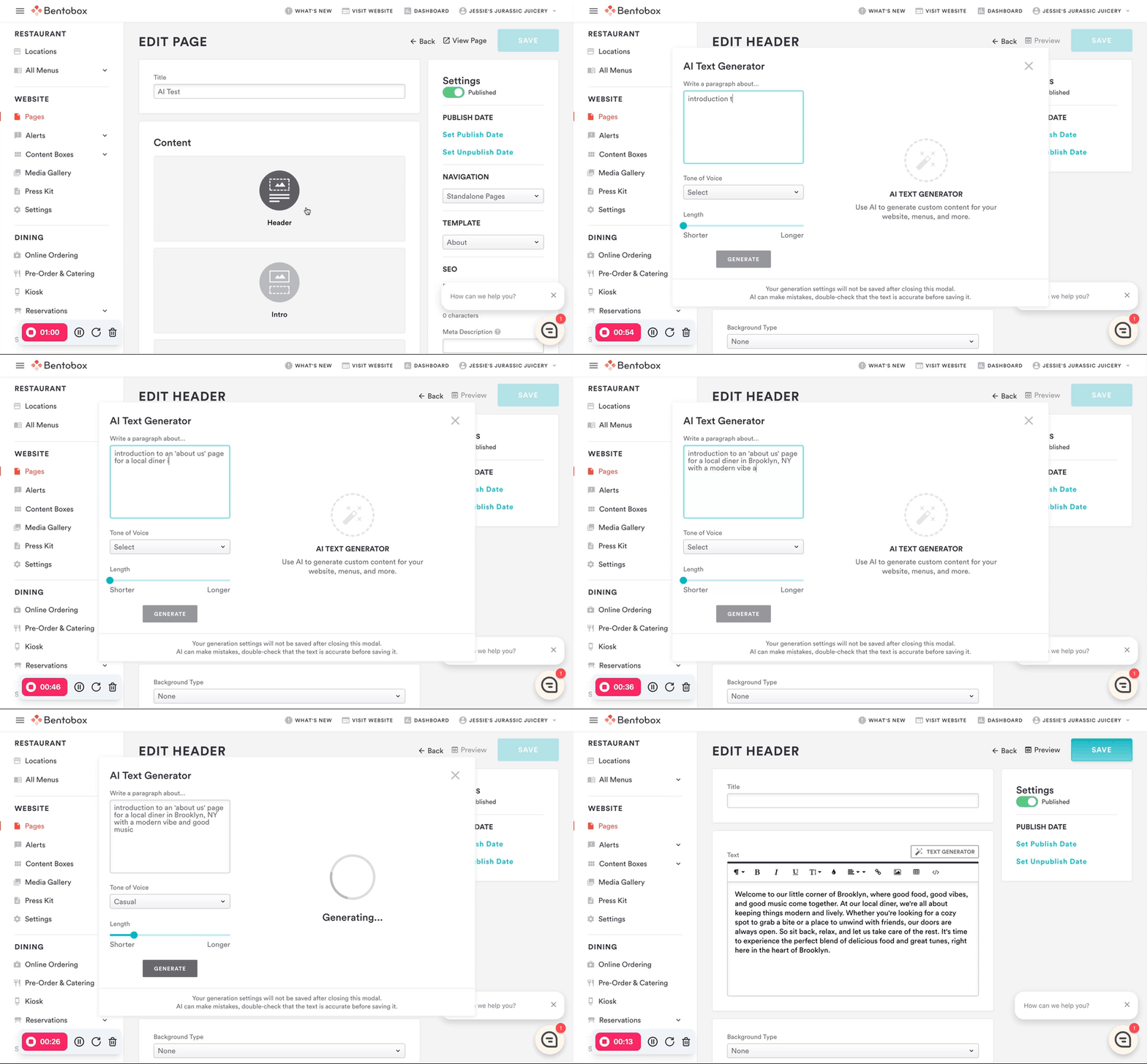
The AI content generation suite shipped across the platform's primary content surfaces. Menu descriptions, email marketing campaigns, social posts, and hero image suggestions, all powered by AI tuned to each restaurant's existing voice and content. The interface for each tool was opinionated: lead with three drafts, allow inline editing, save voice preferences to improve future outputs, never show a blank field.

The trust layer was as much of the work as the AI itself. Every AI-generated output was clearly marked as such, every output was editable inline, and every output learned from the operator's edits. If a restaurant consistently rejected the "casual neighborhood spot" tone in favor of "refined modern bistro," the system learned that within three uses. The AI got better the longer the operator used it, which created a retention loop the previous content tools did not have.

## Outcome
Content creation time compressed from hours to minutes for the operators who adopted the tools. The platform's self-serve adoption metric, which had been the primary leverage point, accelerated meaningfully through the rollout. The AI content tools were one of the differentiated capabilities Fiserv evaluated when it acquired BentoBox at $320M, contributing directly to the strategic case for the deal. Post-acquisition, the AI tooling and onboarding work was rebuilt to scale across Clover's 125,000+ merchant base, taking the system from 14,000 restaurants to a much larger surface.
The lesson the work taught me, which I am still applying, is that production AI design in 2026 is mostly about trust. The AI capability itself is becoming commoditized, but the design decisions around how AI is presented, how it learns, how it admits uncertainty, and how it stays out of the way when the user knows better, those are where the actual product is built.
## Reflection
The thing I would do differently is start with the failure modes, not the success modes. We designed the menu description generator around the case where it produced a great description. We should have designed it around the case where it produced a mediocre description and the operator had to fix it, because that was actually the more common interaction. The product survived because the AI was tuned well enough that the failure case was tolerable, but if we had started with the failure case as the design constraint, the editing interface would have been better from day one. In AI design, the question is not what does the AI do well, it is what happens when the AI is wrong. That is the question I have been starting with on every AI surface I have designed since.